AI Multiplies What You Bring
AI scales your skills, judgment and domain knowledge, and it scales your gaps just as fast.
Most conversations about AI at work start with replacement: which jobs go, which roles shrink, how many people a team still needs. I think that’s the wrong place to start. In practice AI behaves less like a new worker and more like a multiplier on the one already there.
An amplifier doesn’t make you a better guitarist. It makes you louder. Play well and the whole room hears it. Play badly and the whole room hears that too.
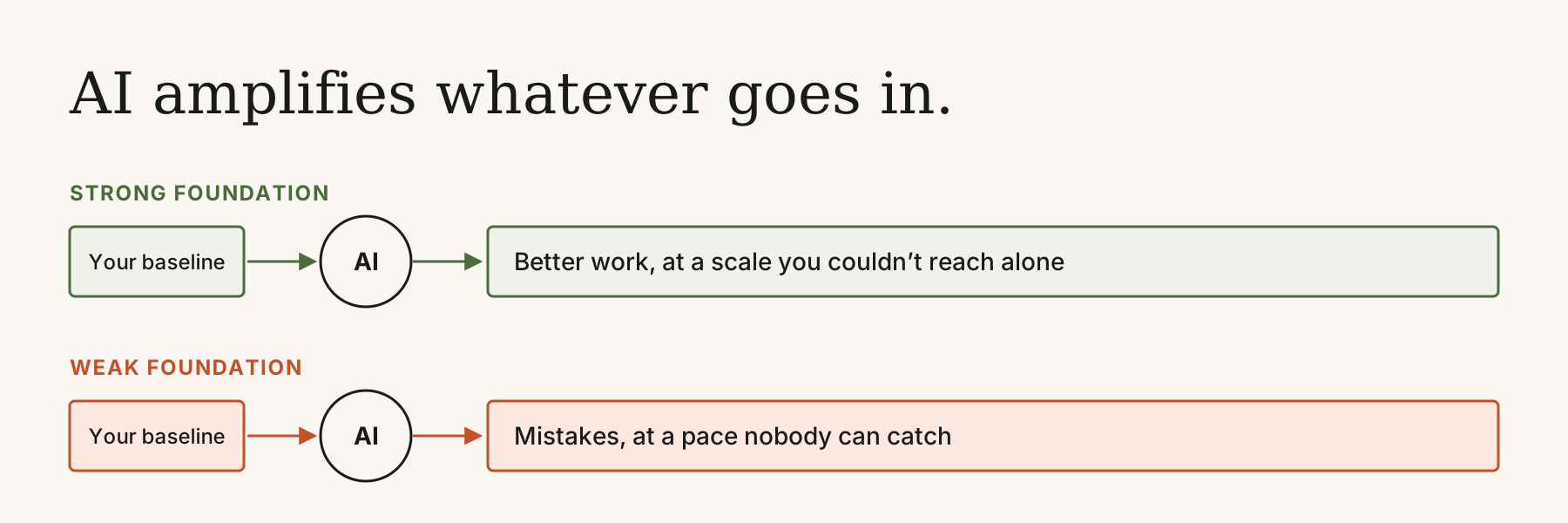
Strong foundations get stronger
Give a capable engineer a capable model and the work changes shape. They already know what good looks like, so they can ask for it precisely, notice when the answer drifts, and push it back on course. The model does the typing. They do the thinking. Work that took a week becomes an afternoon of directing and reviewing.
That isn’t because the model is smarter than they are. It’s because they can tell when it’s wrong.
Weak foundations get exposed
The same tool in less experienced hands produces something that looks just as finished: clean formatting, confident explanations, code that compiles. The difference is that nobody in the loop can tell what’s missing.
At AI speed, mistakes don’t arrive one at a time. A misunderstanding of the domain ends up in ten files, three documents and a customer email before anyone notices. Garbage in, garbage out still holds. It just happens at an industrial pace.
This is the part that concerns me most as a leader. A developer’s mistakes used to be limited by how fast they could type. They aren’t anymore.
Speed changes what’s worth trying
The obvious gain is time saved on individual tasks. The more interesting gain is what becomes cheap enough to try. When a prototype takes an hour instead of a sprint, you build three and throw two away. When exploring an idea costs almost nothing, you explore the ones you would have dismissed.
Teams that use AI to finish the same work faster miss this. Teams that use it to change which work they attempt pull ahead.
The gap is widening
Put those together and the result is uncomfortable. People who already performed well, and who learned to work with AI, are pulling away from everyone else. Some industry voices now talk about 20x or even 100x differences between AI-fluent workers and the rest.
I’m wary of numbers that big. The research I trust shows smaller, messier effects that depend heavily on the task, which I wrote about in AI Is Not Extra Headcount. But the direction matches what I see on teams. The spread is getting wider, not narrower.
What makes the multiplier work
Three things decide whether AI multiplies you up or down.
Domain knowledge
You can’t steer what you can’t evaluate. Knowing your industry, your codebase and your customers is what lets you look at a confident answer and say “no, that’s not how it works here.” It’s also what lets you ask the right question in the first place.
Judgment and agency
AI can generate options all day. It can write the code and draft the document. It can’t decide which problem is worth solving, which trade-off the business can live with, or when to stop. Those calls stay with people, and they matter more now that producing options is cheap.
Active adaptation
The time AI saves has to go somewhere. If it goes into accepting the first draft and moving on, you’ve gained speed and lost quality. If it goes into digging deeper, iterating further or taking on a harder problem, the multiplier compounds.
What this means for leaders
If AI multiplies what people bring, the investment that matters isn’t the licence. It’s the baseline. Domain knowledge, review skills and the habit of questioning output are worth more now, not less. Hiring for judgment, pairing newer developers with people who know the domain, and keeping feedback loops fast enough to catch mistakes early: none of that is new, but all of it pays more than it used to.
AI won’t replace the people on your team. It will show you, faster than anything before it, what they were really bringing.